
LED, Peels and Microneedling, Explained
Three of the most requested non-invasive treatments, what each actually does, and what to expect afterwards.
LED light, superficial peels and microneedling appear on almost every treatment menu now, usually with more adjectives than explanation. Each works on a different principle: one with light, one with acids, one with the skin's own response to a tiny, controlled prompt. Knowing which does what, how a session feels and what the days afterwards look like turns a confusing menu into a calm, informed choice.
This article is editorial and does not replace professional advice. Ask a qualified practitioner about your own skin.
LED light therapy
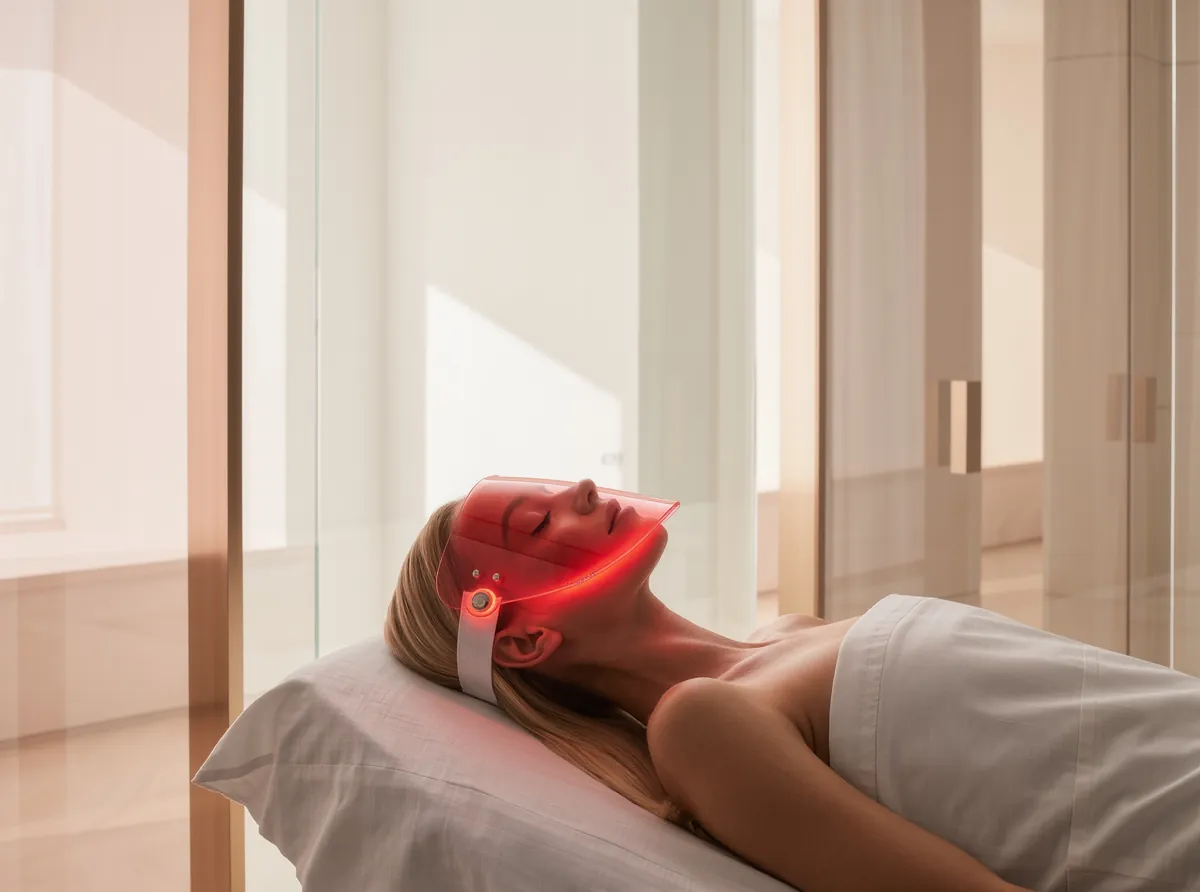
LED stands for light-emitting diode, and in a treatment room it means a panel or mask that bathes the face in a single colour of light at a chosen wavelength. Red light penetrates a little deeper and is used to encourage the cells that make collagen, with a view to firmer, more even-looking skin over time. Blue light stays at the surface and is chosen for skin that is prone to breakouts, where it supports a clearer, calmer complexion. Near-infrared, invisible to the eye, is often combined with red.
A session feels like nothing at all beyond gentle warmth; you lie with protective goggles on for ten to twenty minutes while the panel glows. There is no downtime, no peeling and no need to hide afterwards, which is why LED is so often added to the end of a facial. It is a treatment of accumulation rather than drama: a course of eight to twelve sessions over a few weeks, then occasional maintenance, is the usual pattern, and results arrive gradually.
Superficial peels
A chemical peel is exfoliation by acid rather than by friction. A trained practitioner applies a solution, most often a fruit acid such as glycolic or lactic, or salicylic acid for oilier skin, leaves it for a timed few minutes, then neutralises or removes it. The acid loosens the bonds between dead cells on the surface so they shed more quickly, revealing smoother, brighter skin underneath and encouraging renewal below.
Peels are described by depth. The superficial peels found in salons work on the outermost layer only; they tingle, sometimes quite warmly, for a few minutes and leave the skin pink for a few hours. Deeper peels reach further and belong in clinical settings with longer recovery; they are a separate conversation with a qualified professional. For the superficial kind, expect mild dryness or fine flaking for two to five days, and plan your week accordingly.
Sun care is the heart of peel aftercare. Freshly revealed skin is more sensitive to light, so a generous sunscreen every morning, a hat on bright days and no deliberate sunbathing for a fortnight protect the result. Keep the routine simple for a few days: a gentle cleanser, a plain moisturiser, and no acids, scrubs or retinoids until the skin feels entirely normal again.
The best treatment is the one you understood before you booked it.
Microneedling
Microneedling uses a pen or roller fitted with very fine, sterile needles to make thousands of microscopic channels in the upper skin. The channels close within hours, but the skin registers the prompt and responds as it would to any small disturbance: by producing fresh collagen and renewing itself. Over a course of treatments, this shows as smoother texture, softer fine lines, a more even surface and a particular, long-lasting glow.
This is a treatment to have only from a qualified practitioner in a clean clinical environment, never from a device bought for home use at any real depth. A good practitioner cleanses thoroughly, works in sections with a fresh sterile cartridge, keeps the depth appropriate to each area and finishes with soothing, barrier-supporting products. The sensation is a fine prickling, sharper over the forehead and around the mouth, and the face looks and feels sunburnt for a day or two.
Aftercare is gentle and brief. For the first day, nothing but what the practitioner applied; then a mild cleanser, a simple hydrating serum and moisturiser, and sunscreen as soon as the skin is comfortable. Makeup, active ingredients, saunas, pools and heavy exercise wait a few days. Three to six sessions, spaced four to six weeks apart, is a typical course.
Choosing between them
Think of the three as answers to different questions. LED is the gentlest and suits almost everyone, including as a maintenance habit between other treatments. A superficial peel is the quickest route to brighter, smoother skin before an occasion, with a few days of flaking as the price. Microneedling asks the most of you, in sensation and recovery, and offers the most in the way of lasting texture change.
In every case, a consultation comes first. A qualified professional will look at your skin, ask about your routine and your history, and tell you honestly which treatment, if any, suits you now. They may also combine them: LED after a peel or after microneedling is common, because the light calms and supports the skin's response.
None of these treatments is a shortcut, and that is rather the point. Each asks the skin to do something it already knows how to do, renew itself, and simply gives it a well-timed reason. Choose with a professional you trust, follow the aftercare with more patience than you think you need, and let the results arrive on their own calm schedule.
Questions, answered
Does LED light therapy hurt or damage the skin?
No. The light is cool or gently warm, the eyes are shielded with goggles and there is no downtime. LED does not use ultraviolet wavelengths, so it does not tan or burn. Its limits are patience and consistency: results come from a course of sessions rather than from a single visit.
How long does the skin peel after a superficial peel?
Usually two to five days of mild dryness and fine flaking, though some people barely flake at all, which does not mean the peel has failed. Keep the skin moisturised, resist picking and wear sunscreen daily. Deeper peels have longer recovery and are discussed individually with a qualified professional.
Can I do microneedling at home?
Home rollers with very short needles exist, but anything that reaches a depth capable of real change belongs in a clinic, with sterile cartridges, trained hands and proper preparation. The skin's response depends on controlled, even depth and scrupulous hygiene, which are hard to guarantee at a bathroom mirror. Ask a professional first.
Three terms
- Wavelength
- The colour of light measured in nanometres; red and near-infrared reach deeper into the skin than blue.
- Superficial peel
- An acid-based exfoliation that works on the outermost layer of skin, with pinkness for hours and light flaking for a few days.
- Collagen induction
- The skin's natural production of fresh collagen in response to a controlled prompt such as microneedling.
Illustration: AI generated.