
Beauty Sleep, the Real Science
What happens to skin and hair at night, and the small changes that make rest work harder for you.
Beauty sleep sounds like something a grandmother would say, which is usually a sign that it is true. While you lie still, your skin and hair are anything but idle: cells divide faster, collagen is laid down, blood flow rises and the stress hormone that kept you alert all day finally falls. Understanding the night shift makes it easier to work with it. Here is what happens, and the small adjustments that help.
The night shift
Skin follows a daily rhythm. By day it is in protective mode, thickening its surface slightly against light and the elements. In the evening, as light fades and melatonin rises, the balance shifts towards repair. Cell division in the deepest layer of the epidermis reaches its peak in the small hours, which is how the surface is renewed, and collagen, the protein scaffold that keeps skin firm, is produced most actively during deep sleep.
Two other things happen that you can feel. Blood flow to the skin increases at night, delivering oxygen and nutrients, and cortisol, the hormone of alertness, drops to its lowest point. High cortisol over long periods makes skin reactive and slows its recovery; its nightly fall is the quiet reset that lets the barrier mend. Hair follicles share the rhythm, doing much of their growth work while you are unaware of it.
Regular hours beat long hours
The single most effective change is also the least glamorous: go to bed and get up at roughly the same time, including at weekends. The body's clock sets the timing of repair, and it keeps better time when the schedule is predictable. Seven to nine hours suits most adults; the quality of those hours matters as much as the number.
Keep the bedroom cool, around eighteen degrees, and as dark as you can make it. Light through the eyelids delays the fall of cortisol and the rise of melatonin, so cover standby lights and consider a soft eye mask if the room never gets properly dark. Finish eating two or three hours before bed, and treat late alcohol with suspicion: it helps you fall asleep and then fragments the second half of the night, when the deepest repair happens, and it leaves the skin dehydrated and flushed by morning.
Friction, pillows and posture
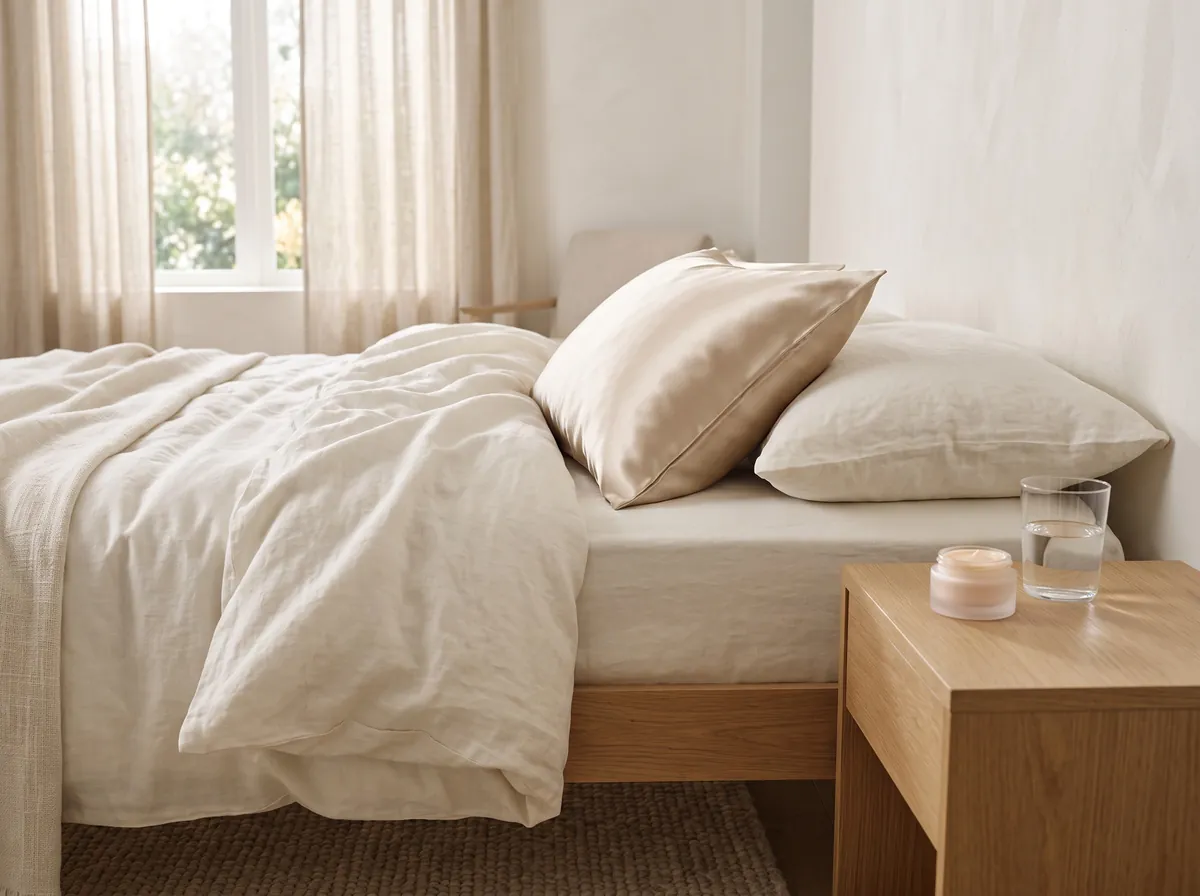
Several hours a night with one side of your face pressed into fabric is not nothing. A silk or satin pillowcase lets the skin and hair slide rather than drag, which means fewer creases in the morning, less frizz and less breakage at the hairline. Change pillowcases often; they collect oil, product and the day's dust.
Sleeping on your back spares the face entirely and lets fluid drain evenly, though most of us roll in the night without noticing. Rather than fighting it, raise your head slightly with a second pillow or a wedge; gravity will do some of the de-puffing before you wake. Side sleepers can loop a loose silk scrunchie around long hair to keep it from tangling.
Every good morning in the mirror was arranged the night before.
What to put on, and when to drink
Night is when richer textures earn their place. Without sunscreen and makeup in the way, and with the barrier more permeable, a cream or balm heavier than your daytime moisturiser is well used. Apply it a little before bed rather than at the last second, so it has settled into the skin instead of transferring to the pillow. A few drops of facial oil pressed over the top suit dry skin in winter.
Hydration is a daytime habit. Drinking a large glass of water right before bed mostly guarantees puffiness and a trip to the bathroom at three in the morning; drinking steadily through the day is what the skin actually registers. Keep a glass by the bed for the morning instead.
To ease the puffiness that greets most of us on waking:
- Rinse the face with cool water, then press a cold, damp flannel over the eyes for a minute.
- Sweep the fingertips lightly from the centre of the face outwards and down the neck.
- Drink that glass of water and open the curtains; light and movement both help.
- Keep eye cream in the fridge; the chill alone reduces the look of swelling.
None of this is complicated, and that is its charm. Sleep asks for nothing you must buy, only for a regular hour, a cool dark room, a smooth pillow and a little restraint with the wine. In return it gives the kind of complexion that no product can quite imitate: rested, even, quietly bright. Treat the night as part of your routine rather than the gap between routines, and the mirror will show you the difference.
Questions, answered
How many hours of sleep does skin need?
Seven to nine hours suits most adults, but regularity matters as much as length. Repair processes are timed by the body clock, and they run best when bedtime and waking time barely vary. A consistent seven hours will usually show on the skin more kindly than an erratic mix of five and ten.
Do silk pillowcases make a real difference?
A modest, practical one. Silk and satin create less friction than cotton, so hair tangles and breaks less and the face is less creased on waking. They do not add anything to the skin; they simply take less away. Wash them as often as you would any pillowcase.
Why is my face puffy in the morning?
Lying flat for hours lets fluid settle in the face, particularly around the eyes, and salt, alcohol or a late meal make it more noticeable. It is normal and temporary. Cool water, a gentle outward sweep with the fingertips, a glass of water and a few upright minutes usually clear it within half an hour.
Three terms
- Collagen
- The structural protein that gives skin its firmness and resilience, produced most actively during deep sleep.
- Cortisol
- The body's alertness hormone, highest in the morning and lowest at night, when its fall allows skin to recover.
- Melatonin
- The hormone released as light fades that signals the body to prepare for sleep and sets the timing of overnight repair.
Illustration: AI generated.