
Abhyanga: The Ayurvedic Oil Ritual
Warm oil, slow strokes and the three doshas: the self-massage that India has practised for millennia.
Abhyanga is the Ayurvedic practice of anointing the whole body with warm oil, slowly and by your own hand. It takes a small bowl, twenty quiet minutes and a towel you do not mind staining. In return it offers something modern routines rarely do: time spent with your own skin, from scalp to sole, before the day begins. Here is where the ritual comes from and how to do it well.
A Tradition of Balance
Ayurveda is one of the oldest systems of living well, with roots in the Indian subcontinent that reach back several thousand years. Its name is usually translated as the knowledge of life, and its concern is balance: between the body and its surroundings, between activity and rest, between the seasons and the self. Daily rituals, called dinacharya, are the practical expression of that idea, and abhyanga is among the most cherished of them.
Within this tradition, the Sanskrit word sneha means both oil and love. To oil the body is understood as an act of affection towards oneself, which explains why the practice is described in such tender terms in classical texts and why it has never gone out of fashion in Indian households.
The Three Doshas, Briefly
Ayurvedic thought describes three doshas, or constitutional patterns, that combine differently in every person. Vata is associated with air and movement: lightness, dryness, quickness. Pitta is linked with fire: warmth, intensity, sharp focus. Kapha carries the qualities of earth and water: steadiness, softness, calm. Everyone has all three; the proportions, and the way they shift with age and weather, are what make a constitution.
The doshas guide the choice of oil and the manner of massage. In the tradition, warming sesame oil is the classic choice where vata is thought to dominate, cooling coconut oil where pitta runs high, and lighter oils such as sunflower or almond, used more sparingly, where kapha is strong. Within a beauty routine you can hold this more loosely: choose the oil whose texture and warmth your skin enjoys, and notice how that changes with the seasons.
Preparing the Oil
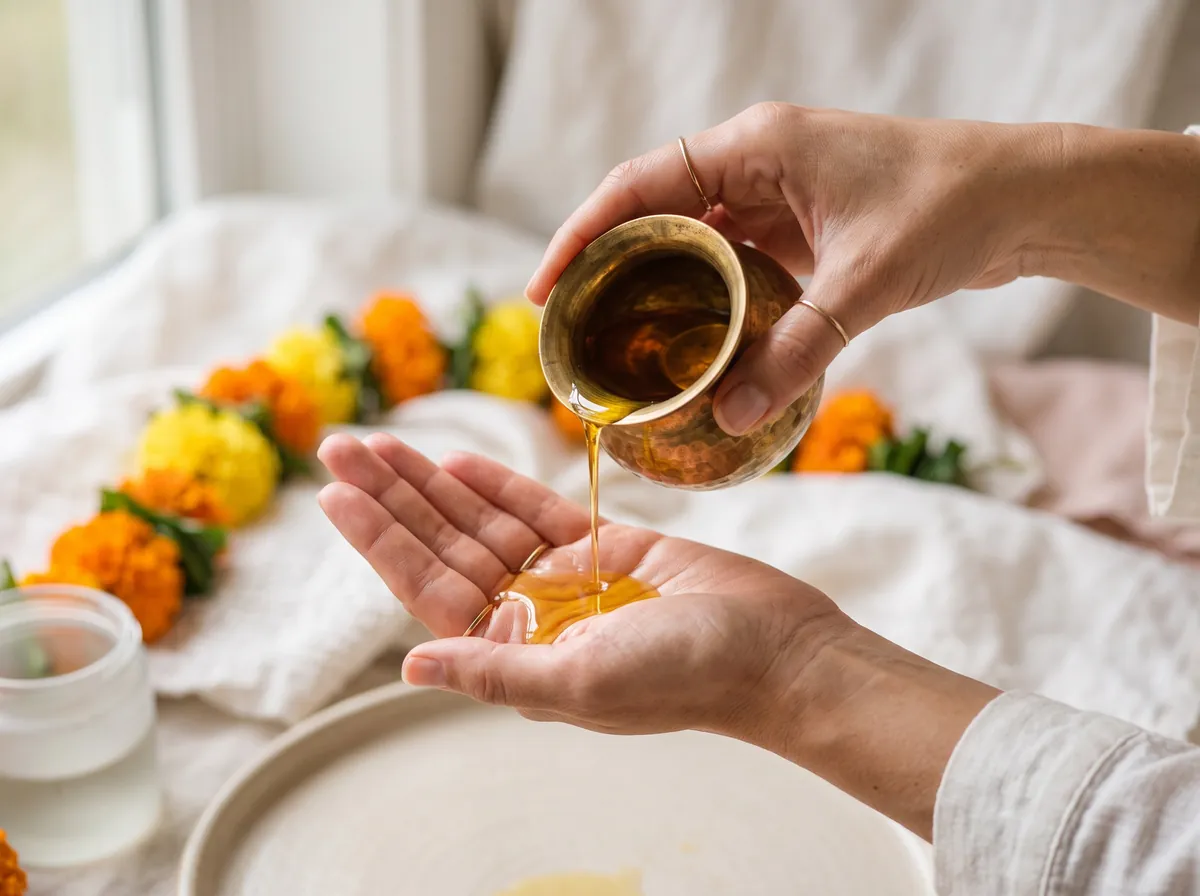
Warmth is essential. Pour two to four tablespoons of oil into a small bowl and stand it in a larger bowl of hot water for a few minutes, or warm the closed bottle under a hot tap, until the oil feels pleasantly warm on the inside of your wrist. Never heat it directly. Lay a towel on the floor of a warm bathroom, close the door and keep the room draught-free. Some people add a drop or two of a favourite essential oil, though plain oil is traditional and entirely sufficient.
The Sequence
Begin at the top. Pour a little oil into your palm and work it into the scalp with the pads of your fingers in small circles, as if washing your hair very slowly. Move to the face with a lighter touch: upward strokes along the jaw and cheeks, gentle circles at the temples, a soft press at the brow. Then the ears and neck, which are easily forgotten and deeply pleasant to attend to.
From there, the body follows a simple rule:
- Long, flowing strokes along the length of the arms and legs, always towards the heart.
- Round, unhurried circles over the joints: shoulders, elbows, wrists, hips, knees and ankles.
- Broad clockwise circles on the abdomen and chest, with the flat of the hand.
- Firm attention to the feet, from the heels to the spaces between the toes.
Fifteen to twenty minutes is a comfortable length. Keep the pressure moderate and the pace even; you are not trying to work anything out, only to cover every inch with warmth. When you finish, sit or lie for five to ten minutes so the oil can settle, then take a warm shower. A gentle cleanser, or a little chickpea flour mixed with water, removes the excess and leaves the skin soft and lightly veiled rather than squeaky.
The hand that oils the body teaches the mind to arrive in it.
Why People Keep Doing It
Tradition places abhyanga in the morning, before bathing, when the body is rested and the day has not yet claimed your attention. In practice, the evening works beautifully too, and many people alternate. What matters is the regularity, and that regularity is easier to keep than you might expect, because the ritual is so pleasant.
Ask anyone who oils daily why they continue and the answers are rarely about the skin alone, although skin that is oiled every morning does feel supple and look softly polished. They speak of the warmth that lasts through the day, of feeling settled and contained, of twenty minutes in which nothing is asked of them. The ritual becomes a hinge between sleep and the world.
Abhyanga asks you to slow down enough to touch your own body with care, which is a surprisingly radical thing to do before breakfast. Start with twice a week, let the oil warm while the kettle boils, and see how long it takes before the mornings you skip it feel like something is missing.
Questions, answered
Which oil should I use for abhyanga?
Sesame oil is the classic choice in the tradition, valued for its warmth and the way it suits most skin. Coconut oil is used where a cooling feel is preferred, and almond or sunflower oil where something lighter is wanted. Choose a plain, good-quality oil and warm it gently before use.
How long should the oil stay on before I shower?
Five to ten minutes of rest after the massage is usual, long enough for the oil to settle into the skin and for your breathing to slow. Then wipe away the excess with a cloth and take a warm, not hot, shower. A gentle cleanser removes whatever remains.
Is abhyanga suitable every day?
Daily practice is traditional and many people find it comfortable, especially in the cooler months. If your skin is naturally oily or the weather is humid, two or three times a week, with a lighter oil, may feel better. Let how your skin feels afterwards guide the rhythm.
Three terms
- Dinacharya
- The Ayurvedic daily routine, a sequence of morning and evening rituals that includes abhyanga.
- Dosha
- One of the three constitutional patterns in Ayurvedic thought: vata, pitta and kapha.
- Sneha
- A Sanskrit word meaning both oil and love, which gives abhyanga its tender character.
Illustration: AI generated.